

FLASH Research : Changes in workplace Violence indicators across the Five Cycles of ELOSMET
This Research FLASH presents preliminary findings on changes over time in workplace violence among the 7,222 individuals from 98 workplaces who participated in the Longitudinal Study of the Observatory on Health and Well-being at Work (ELOSMET). The study consists of an online survey launched in 2019 that is annually repeated over a six-year period. It addresses various aspects of health and well-being at work, as well as a range of work conditions, non-work factors, and personal characteristics.
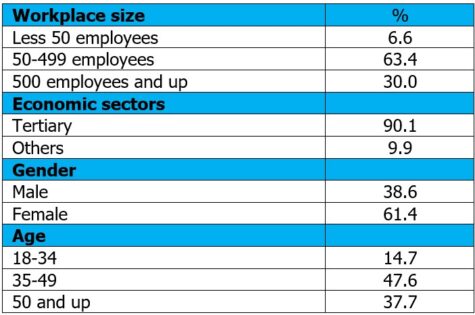
Data collection for Cycle-1 covered the period 2019-2021 (n=3025), Cycle-2 2020-2022 (n=3500), Cycle-3 2021-2023 (n=2948), Cycle-4 2022-2024 (n=1786) and Cycle-5 2023-2025 (n=15830). The response rate varied between 37% and 63% depending on the cycle. The following table presents the main sociodemographic and workplace characteristics of this sample.
Violence was measured using eight indicators, formulated as questions about situations experienced in the workplace over the past twelve months. The questions cover various forms of violence, including interpersonal conflicts (having had an argument with someone, having been yelled at, treated rudely, openly blamed by someone or having been the target of someone’s bad mood) (Harvey et al., 2006). Violence also includes harassment, including physical harassment (being subjected to physical violence), psychological harassment (being subjected to intimidation), and sexual harassment (being subjected to unwanted sexual conduct, comment, gesture or contact) (Daveluy et al., 2000). The results focus on the prevalence of individuals who have reported experiencing these behaviours sometimes, often or very often.
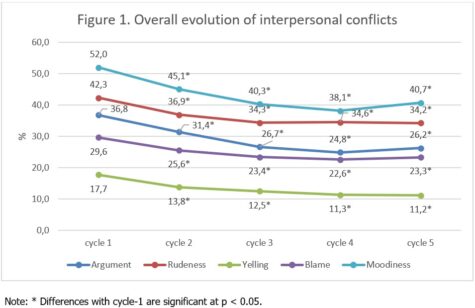
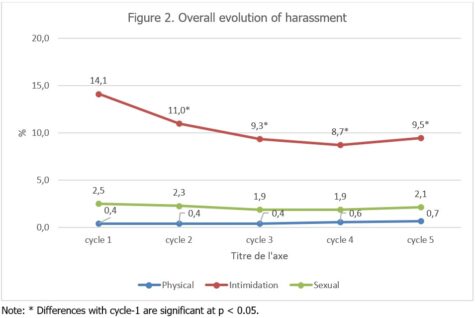
Figures 1 and 2 illustrate variations of violence at work over the five cycles among all respondents.
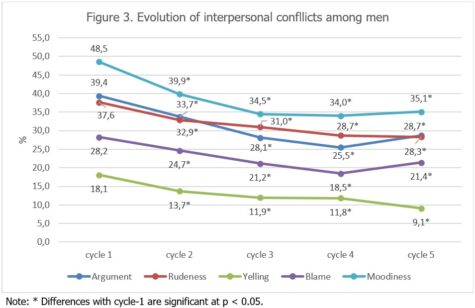
Figures 3 through 6 show variations of violence at work among men and women.
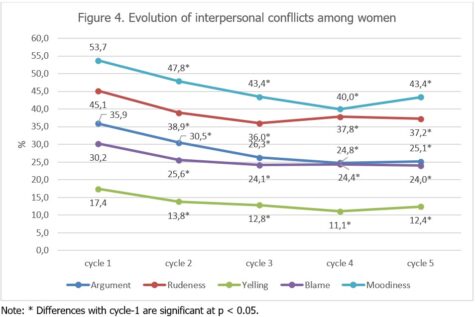
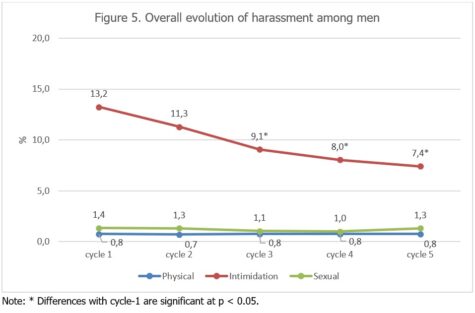
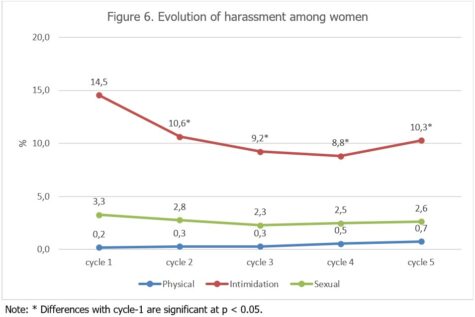
The findings are as follows:
- Overall:
- The indicators of violence are ranked in order of importance as follows:
- 1. Been the target of someone’s bad mood (40,7%-52,0%)
- 2. Been treated rudely (34.2%-42.3%)
- 3. Had an argument (26.2%-36.8%)
- 4. Been openly blamed (23.3%-29.6%)
- 5. Been yelled at (11.2%-17.7%)
- 6. Intimidation (9.5%-14.1%)
- 7. Sexual violence (2.1%-2.5%)
- 8. Physical violence (0.4%-0.7%).
- The indicators of violence are ranked in order of importance as follows:
-
- Between Cycle 1 and Cycle 5, the prevalence of indicators of interpersonal conflict decreased by between 6.3% (being openly blamed by someone) and 11.3% (being the target of someone’s bad mood). The prevalence of psychological harassment (intimidation) decreased by 4.6%, while physical and sexual violence remained stable.
- The prevalence of indicators such as being the target of someone’s bad mood, having an argument with someone, and being intimidated appears to have increased by Cycle 5.
- Regarding gender differences :
- Overall, men and women appear to differ, with women showing a higher prevalence of sexual violence, being the target of someone’s bad mood, and experiencing rudeness, while men appear to be more frequently exposed to arguments.
- Changes in violence indicators over time suggest an increase at Cycle 5 among men in being the target of someone’s bad mood, having had an argument with someone, and having been openly blamed by someone. Among women, being the target of someone’s bad mood and experiencing intimidation increased between Cycles 4 and 5.
Conclusion
The ELOSMET is conducted among a large sample of workers across a wide variety of workplace settings, making it possible to identify important trends in the evolution of workplace violence as well as variations by gender.
Overall, although preliminary, the results highlight a gradual decline in interpersonal conflicts and harassment between Cycles 1 and 4 (2019–2024), suggesting an improvement in the work climate during this period marked by the COVID‑19 pandemic. Lockdowns, remote work, and hybrid work arrangements (on‑site and remote work) likely contributed to reduced exposure to various forms of workplace violence. As the return to on‑site work intensified after Cycle 3, certain behaviours appear to have emerged more strongly in everyday work life, such as displays of bad moods, blaming, arguing, and intimidation. This modest resurgence does not negate the gains achieved previously, but it does raise a warning signal. The prevalence of interpersonal conflicts and workplace harassment remains very high. Based on ELOSMET data, exposure to at least one of the eight indicators of violence affected 68.5% of individuals in 2019–2021 and 58.5% in 2023–2025. Women showed a prevalence that was 6% to 7% higher than that of men.
The results presented here do not, of course, allow for the identification of the factors underlying these fluctuations. The observed increase may be associated with recent contextual or organizational changes, including the return to on‑site work. It may also reflect a greater likelihood among individuals to recognize and report such experiences. With the modernization of Québec’s occupational health and safety system, the recognition of psychosocial risks—such as workplace violence—will serve as a powerful lever to strengthen prevention efforts in this area.
Gender based analyses indicate that women and men display broadly similar trajectories of increase and decrease over time; however, women appear overall to be more affected by violence at work than men. Nevertheless, differences emerge depending on the type of violence, revealing distinct profiles. These findings support the conclusion that men and women are not exposed to the same forms of violence. Such distinct profiles underscore the importance of adopting a tailored approach to understanding and preventing psychosocial risks, particularly with respect to workplace violence.
In sum, the results of this Research Flash demonstrate that workplace violence represents a major issue that can affect a substantial proportion of individuals within an organization, and that the way interpersonal conflicts and workplace harassment are experienced differs by gender.
References
Daveluy, C. L. N. R., Pica, L., Audet, N., Courtemanche, R. et Lapointe, F. (2000). Enquête sociale et de santé 1998 Québec.
Harvey, S., Blouin, C. et Stout, D. (2006). Proactive personality as a moderator of outcomes for young workers experiencing conflict at work. Personality and Individual Differences, 40(5), 1063-1074.
Website: https://www.osmet.umontreal.ca/en/
About OSMET
The Observatoire sur la santé et le mieux-être au travail (OSMET) was born of a collaboration between the Faculty of Arts and Sciences, the Institut de recherche en santé publique (now the Centre de recherche en santé publique) and the School of Industrial Relations of the Université de Montréal. OSMET receives financial support from four founding partners: TELUS Health (formerly Morneau Shepell, then LifeWorks Wellness Solutions), McKesson Canada, Medavie Blue Cross and Pratt & Whitney Canada.
The OSMET Flash Research Collection
- Mental health in Cycle 5 : contribution of work, non-work and individual factors. November 2025. https://www.osmet.umontreal.ca/en/flash-recherche-contribution-des-facteurs-du-travail-hors-travail-et-individuels/
- Changes in mental health indicators over the five cycles of ELOSMET. June 2025. https://www.osmet.umontreal.ca/en/flash-recherche-evolution-des-indicateurs-de-sante-mentale-aux-cinq-cycles-de-lelosmet/
- How is the mental health of managers? December 2024. https://www.osmet.umontreal.ca/en/flash-recherche-comment-ca-va-la-sante-mentale-des-cadres/
- Evolution of mental health indicators in the first three cycles of ELOSMET study. July 2023. https://www.osmet.umontreal.ca/en/flash-recherche-levolution-des-indicateurs-de-sante-mentale-dans-les-trois-premiers-cycles-de-lelosmet/
- Mental health in Cycle 4: Contribution of work, non-work and individual factors. July 2024. https://www.osmet.umontreal.ca/en/flash-recherche-la-sante-mentale-au-cycle-4-contribution-des-facteurs-du-travail-hors-travail-et-individuels/
- Mental health in Cycle 3: Contribution of work, non-work, and individual factors. December 2023. https://www.osmet.umontreal.ca/en/flash-recherche-la-sante-mentale-au-cycle-3-contribution-des-facteurs-du-travail-hors-travail-et-individuels/
- Evolution of mental health indicators in the first three cycles of ELOSMET study. July 2023. https://www.osmet.umontreal.ca/en/flash-recherche-levolution-des-indicateurs-de-sante-mentale-dans-les-trois-premiers-cycles-de-lelosmet/
- Prevalence of mental health problems in the workplace during COVID-19: ELOSMET Cycle 2 results. November 2022. https://www.osmet.umontreal.ca/en/flash-recherche-prevalence-des-problemes-de-sante-mentale-en-milieux-de-travail-pendant-la-covid-19-les-resultats-du-cycle-2-de-lelosmet/
- Mental Health in Cycle 2 of ELOSMET study. October 2022. https://www.osmet.umontreal.ca/en/flash-recherche-la-sante-mentale-au-cycle-2-de-lelosmet/
- The best practices for intervening and reducing mental health problems in the workplace. May 2022. https://www.osmet.umontreal.ca/en/flash-recherche-les-meilleures-pratiques-pour-intervenir-et-diminuer-les-problemes-de-sante-mentale-au-travail/
- Psychological distress and burnout: Contribution of work, non-work, and individual factors. October 2021. https://www.osmet.umontreal.ca/en/flash-recherche-detresse-psychologique-et-epuisement-professionnel-contribution-des-facteurs-du-travail-hors-travail-et-individuels/
- Portrait of the implementation of occupational health and wellness management practices. June 2021. https://www.osmet.umontreal.ca/en/flash-recherche-les-pratiques-de-gestion-de-la-sante-et-du-mieux-etre-au-travail/
- Mental health in the workplace during a pandemic: Early results from ELOSMET Cycle-1. January 2021. https://www.osmet.umontreal.ca/en/flash-recherche-la-sante-mentale-en-milieux-de-travail-en-temps-de-pandemie/
- Absenteeism and workplace health and wellness management practices. October 2020. https://www.osmet.umontreal.ca/en/flash-recherche-labsenteisme-et-les-pratiques-de-gestion-en-sante-et-mieux-etre-au-travail/
- Telework, working conditions and work-family conflicts. June 2020. https://www.osmet.umontreal.ca/en/flash-recherche-teletravail-conditions-de-travail-et-conflits-travail-famille/
This content has been updated on 3 mai 2026 at 21h27.